The New Silence

London, 1889, and malicious eyes, surrounded by thick, dark makeup that the viewer might suppose is meant to be soot, stare out from a dark alleyway, through the Victorian fog, at a passing victim. The killer grins as his knife gleams in the gaslight. The victim sees the gleam, but, alas, too late. He is dragged into the alleyway and we cut to a close-up of the knife passing across the flesh of his throat. The body slumps onto the pavement at the feet of two passersby. The woman screams, while her companion, a moustached, monocled man, calls for help
Title card: Police! Murder! Police
So begins the silent film “Harry the Tramp” (or Harry le Clochard, to give it its original French title), which was filmed in January 1920 and intended for release later that year.
The film never saw the light of day - at least, not officially - being banned due to graphic violence that angered and disturbed the few financiers and studio heads that saw it.
Harry is now remembered only by aficionados of the more obscure corners of cinema history. However, those who know of him share a secret and, in some cases, a passion, for there are whispers, there are theories. Some believe there is evidence too.
“Of what?” you ask, impatiently.
Of the authenticity of the deaths depicted onscreen.
You understand what is meant by that.
Harry the Tramp is said to have been a snuff film.
And who is this? Where are we now? We are looking at heavy, dark-green storm doors, closed against the silently falling snow. The house looks wealthy. I can assure you that it is.
Two men stand before the doors. One pushes them open while the other lights a cigarette. It is so cold. The smoker’s jacket is long and expensive, as is the scarf he has tucked into it, keeping the snowflakes from his collar. There is no wind. The other man’s jacket looks like leather, but it is not. A black hoodie provides an extra layer. His cheap boots are already letting in.
“Here?” he asks, looking up at the sandstone edifice. “I usually never go near the West End.”
“I don’t blame you,” I reply, for I am the smoker, and I have brought him here.
“Too much security.”
“Yes.”
“Too much risk.”
“No risk tonight, my friend.”
“Yeah?”
“I guarantee.”
He already knows he is going to do it, having got so close. He can feel the thrill, the trembling caused by adrenaline.
He was alone when we met. It was a chance meeting, or so we both believed. Having thought the thing through, I have concluded that, given the stakes involved, chance cannot possibly have played any part.
The pub that we had both chosen to drink in that night was inexpensive, anonymously cavernous. Ideal for those who wished to disappear into the nightlife.
I overheard him talking to a girl who, being nonplussed at having received an unasked-for potted history of silent horror films, was now excusing herself.
“I’ll be back,” she said, moving off towards the toilets.
“No, she won’t,” I told him as I took her seat at the bar.
He turned to look at me. “I think you’re right. Girls nowadays: no appreciation of art.”
“None whatsoever. I’m Finnick.”
He laughed as we shook hands and said, “You’re what?”
“Finnick.”
“I’m Gavin. Not as cool.”
“As?”
“Your name.”
“Oh! Yes, sorry. It’s a little unusual. Can I buy you a drink?”
“Same again, thanks.”
“I couldn’t help overhearing what you were talking about,” I said as he drank his pint. “Silent films are a passion of mine too.”
“We’re a rare breed.”
I agreed that we were and we entered into a discussion about his particular passion - the horror films of that era, works rendered all the more affecting by their lack of sound, and by the stark beauty of their cinematography, the use of shadows and light, the power that a look or gesture can carry, dialogue doing only what the images cannot, and carrying the plot forward, always forward.
We met many times over the course of the next year until I had sold myself as a kindred spirit and he began taking me into his confidence. He was planning a film of his own, but not just any film, one in the vein of the murderous little tramp himself, grinning Harry, who had haunted old London town so very long ago.
“I’m creating a new genre, one that fuses the elegance of silent film and the visceral thrill of found-footage. I call it Nouveau Silence.”
“Sounds very exciting. When do you shoot? Do you have a cast? A location?”
“It’ll all be shot on my phone. Soderbergh showed the possibilities there. And as soon as possible. As for location and cast, I have neither.”
“I see.”
In my head I could see the tentatively sketched first lines of a design much grander than his little project. I knew, however, that I had to proceed with caution.
#
“I’ll interpret any of your dreams for a small fee. Well? Anyone care to cross my palm with silver?”
“No, thank you, Phineas. And don’t go offering your services to my wife either. My daughter shut herself up in her room for three days after one of your readings.”
“Dark dreams, dark interpretations. I am not to blame.”
“Most soothsayers pull their punches if they see something frightening.”
“I’m no soothsayer.”
“You know what I mean.”
This exchange was taking place at our club, the one we meet at every month, “we” being a group comprised of three men and three women with a very particular purpose. Phineas does indeed have a gift for interpreting dreams, and I was the one reprimanding him for his often irresponsible use of that gift.
“To return to the subject of my proposal,” I said, addressing the rest of the group as a whole.
“It’s solves our problem with elegance, and not a little wit,” replied Neesha. She sat, with her legs crossed, on a red-leather armchair by the fire, and looked very beautiful as always. And, as always, I was a little afraid of her. “I say proceed.”
The others agreed.
“Whatever you dream tonight,” quipped Phineas, “should be very interesting indeed.”
#
“You need a location, I bring you a location,” I told Gavin at our next meeting. “You need a star, I bring you one of great beauty, and a supporting cast of one, an innocent, a little lamb to the slaughter.”
He looked up to see if any of the pub’s other patrons had overheard.
“No one heard. No one cares. No one knows what is afoot, except us,” I assured him. “You are on the verge of greatness. We can shoot tonight, provided you don’t mind a little snow.”
#
And now I present the assembled film, cut together by yours truly. I have a little experience in this field, having attended film school and recognised very quickly that the editing room was where all the power lay. Anyone can shoot a film, but it takes skill to impose a pleasing shape upon it, to dictate the pace. Ah yes, editing is where it is most definitely at.
I haven’t quite managed to create a piece of art, which is unsurprising, considering the material I had to work with. Notwithstanding his passion for the medium, my director was a deluded fellow. Of course, I had to take on the writing of the piece too, inasmuch as dialogue was concerned, which was fun. I took pride in creating the captions, wishing to put on as much of a show as possible.
We open on that snowy street. (I should mention that I am out of shot, taking shelter behind a storm door, watching the snow soundproof the world.) The first of several director cameos now, although we don’t see his face. The mask he has chosen to wear is unique and therefore memorable. Its nose is long, like Pinnochio’s after one lie, the eyes cartoonishly large. Hard to tell its colour, given the black and white cinematography. However, I can reveal that it was flesh-coloured. We cannot see the mouth, covered as it is by a black scarf. He has his hood up and wears a baseball cap on top of that hood. All in all, a positive identification would only be possible if you were to remove the director’s disguise.
Now the director turns the phone towards the door and steps inside. Ah yes, the door is unlocked. Not unusual in this neck of the woods, where wolves are never known to prowl. Here is the type of neighbourhood so rarely encountered nowadays: people call on one another, especially at Christmastime. They let themselves in and call out, “Anyone home?”
There is someone home tonight.
The hallway is dark. We see stairs just ahead; tall, potted plants, one at the bottom and one on the first-floor landing. Gavin pans from side to side in a manner meant to look controlled, but his hand is shaking, and therefore so is the shot. I daresay he can’t believe he’s finally doing it, following in Harry’s hallowed footsteps.
Something - a sound perhaps - captures his attention, causing him to whip-pan to the side. We see a closed door. The living-room.
In he goes. The first thing he sees is a Moses basket. Could this be the lamb of which we spoke? Might the slaughter happen so soon? But no, the basket is empty. The suspense continues to build.
Nothing else of note in here. A white leather couch, a mirror over a white fireplace, upon which is an ornament, a dragon, fashioned from what might very well be gold. We see the director again, his reflection in the mirror, although now obscured by the light of the phone.
Title card: Where is everyone?
Perhaps he is thinking of the sound he heard, wondering if his senses can have been deceiving him.
He backs out of the living-room. Yes, he backs out. There is a sense that he feels eyes upon him. That’s what the shot conveys to me anyway. Hopefully my audience will feel the same way.
Following a cautious pause, he enters the kitchen, which is just to the right of the staircase. Large windows look out onto a stretch of woodland, its bare branches heavy with snow. This gives a sense of being closed in, shut off from the rest of the world. There is a slab of raw meat on the worktop, an electric carving knife beside it.
Another frantic whip-pan. One-eighty. Glowing eyes, that must belong to an animal, or someone on all-fours, stare at him from the doorway, and then are gone in an instant.
Title card: What the fuck!
We see the mask placed on the worktop, along with the cap and scarf. Does he feel that the time for disguises, for gaudy theatrics, has passed?
An opportune moment for an interlude, a chance to catch your breath as I break up the narrative with a behind-the-scenes tidbit. While I waited for Gavin,I saw the ghost of a little boy who was once swept out to sea. Pale-faced and black-eyed, he wandered through the snow, making a sound akin to the keening of one who had suffered an unendurable loss. He was clad still in the shorts and t-shirt in which he had met his end. His feet were bare, and he seemed quite unaware that he was being watched. On he trudged, heedless of the elements.
Now, you might wonder what this meant. At the time, I took it as an omen. A child was, after all, central to tonight’s endeavour. And this little wraith - oh I had recognised him instantly. Not long dead, not really. Five years. A thing of local infamy at the time. “Everyone knew that part of the promenade was dangerous” “It should have been fixed” “Blocked off” “There ought to have been warnings put up.”
I pulled the quotes from memory. Heads rolled; sacrifices were offered up. There must always be a sacrifice.
“An omen,” you say. “Yes, but what does it mean beyond that? What does it mean that you saw him at all.”
I was getting to that. You see, all the members of the club have a gift. Mine, apart from being a decent editor of film, is that I have the sight.
He disappeared eventually. First the snow made him difficult to see, and then I couldn’t see him at all. The keening lingered for a while, and then I heard only the wind, which was definitely starting to get up.
Back to the film.
After a stretch of time (significant enough that I was forced to do a little judicious trimming), Gavin sets off in pursuit of the animal. We see him first bounding up the stairs and then slowing to a more cautious pace.
Title card: Hello?
He has abandoned all pretence of not betraying his presence in the house. He fears being confronted by whoever lives here far less than he fears another encounter with the beast with the glowing eyes.
“Now,” I remember thinking as I toiled in my editing suite, “this next part could most certainly do with a reaction shot, a cut to our director’s eyes as they widen with fear.”
Knowing that such an image existed later in the shoot, I decided to apply a little movie magic. Or you could say that I decided to cheat.
And so we find Gavin frozen at the end of a hallway on the first floor. At the other end, framed by the doorway, stands a woman. Wearing a white nightgown and wielding a pickaxe, she is guarding the nursery. As she runs towards Gavin, we get the brief cheat-cut to his terrified eyes, and then the chaotic, blurry imagery as he flees for his life, all thoughts of art forgotten.
He does, however, collect himself as he hides in a wardrobe.
Title card: I don’t want to turn the camera’s light back on.
Title card: Without it, all I can present to you is a black screen.
Title card: This will be replaced by title cards if I live long enough to finish the film.
Title card: There are four of us in this house.
Title card: Me.
Title card: The woman.
Title card: A child.
Title card: And the animal.
Title card: Wait.
A further confusion of light and whirling images, and then a cut to…
…The director, tied to a chair and gagged, the camera turned on him by his captor, the woman, who now speaks.
Title card: If only you knew who this child is.
Gavin struggles in vain as, projected by a nightlight, Donald Duck floats past in the background, followed by Daisy, and then Pluto.
Cut to a close-up of the woman’s malicious smile.
Title card: And so we come to the finale.
Gavin glances briefly downwards. Of course I can never be certain, but my theory is that this was the moment he realised that he had been expected this night.
The woman turns the phone upon a brilliantly white crib. The flickering light from the anachronistic fireplace makes it look like it is phasing between our world and some Great Beyond.
And lo, the child’s coverings stir, and then there is darkness.
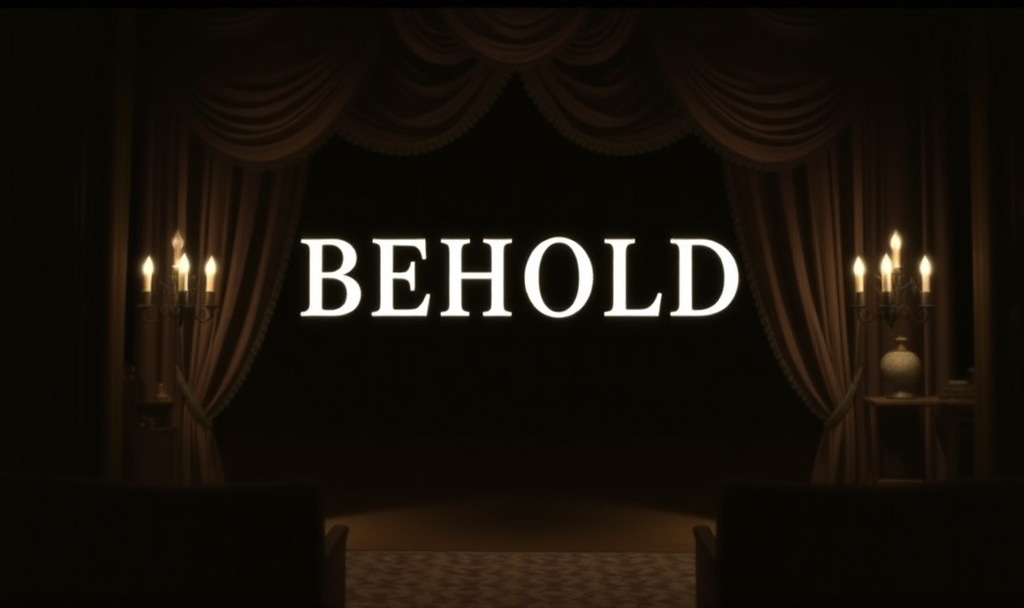
Title card: Behold!
When the light returns, the crib is empty, and a dark figure stands atop it. Naked, sexless, faceless and opaque, it is like a mist trying to become someone.
Neesha, for it is she, is positioning herself for a wide shot: the mist-figure points at Gavin, whose neck twists and breaks.
Then the figure is gone, and the child reappears.
Title card: The End
“Not just of the film, of an entire epoch, one spent in Christ’s chilly shadow.”
That little bon mot is mine. Off the cuff, I assure you.
The room bursts into applause.
The Six (our formal title) have been watching the film, projected as it was, old style, onto a free-standing screen, which lesser members of the club (not part of the Six, but true to our cause) now carry away as the lights come on once more.
We drink toasts to myself, the late director, and finally to Neesha, who stands cradling our Lord.
“My dear,” I tell her, “You were superb.”
She smiles at me, in that distant way that I have grown used to. She stopped being my wife, in any true sense of the word, the moment she was tasked with protecting our Lord. Prolonged life is hers now, of course, as is the honour of receiving Him into herself when He comes of age.
She was chosen, and, simply put, she had to be put to the test. That test had to be documented somehow.
No one ever truly doubted her ability.
Or that of her pet, the worthy Hannibal.